

You used AI.
You submitted the assignment.
Still, you got low grades.
Sounds familiar? So, what went wrong?
This is an experience shared by thousands of students who have used AI for their assignments.
Let me share my experience of using AI
My Experience Using AI for Online Courses
I was pursuing an online degree from a prominent university in the United States. We had our weekly dose of assignments: discussion posts, essays, quizzes, and even a full-length research paper for every subject. At the same time, I was working two part-time jobs and had hired a reliable assignment writer from MAE to help manage my workload.
Yes, I was spending about $250 a week on my assignments, but it was worth the price given the quality I was getting. They provided affordable online course help at low prices.
With straight As coming in, everything seemed to be going perfectly, at least for a while.
Being from Singapore made things easier for me. With a strong command of English, my work rarely raised any suspicion, even though I outsourced most of my assignments. My peers from Korea, China, or Japan could not pull this trick off, though. They had lower proficiency in English, and our professors could easily spot assignments that did not match their usual writing style.
They were hiring assignment helpers too, but often through those spammy looking Chinese websites that cost you a bomb but deliver work that barely passes.
Needless to say, we did not have the option to use ChatGPT or any other AI tool. Turnitin and similar detection tools immediately flagged AI-generated essays as plagiarism, and anyone caught using them had to face lengthy sessions with academic counsellors, and potentially an F grade.
Reality: Everyone is using ChatGPT, so how do you stand out?
Everything changed in the Fall 2025 semester, when our university began allowing the use of ChatGPT in a ‘responsible’ manner. There were some restrictions, like requiring students to acknowledge its use, but to most of us, it meant only one thing: We could now use ChatGPT for our assignments.
I faced a dilemma: Should I continue paying $250 a week to my expert, who had consistently churned out As for me? Or should I use ChatGPT like everyone else and save some money?
Like any budget constrained student would, I chose to save my money and hop on the ChatGPT bandwagon.
Turns out it was a BIG mistake.
So, what went wrong?
Using ChatGPT for discussion posts
The following week, we had a discussion post due. The task was to identify two leaders (one from past and one from present) and compare and contrast their leadership styles. I entered the prompt on ChatGPT and, sure enough, it generated a polished two-paragraph response. I submitted it and hoped that I could continue my streak of A grades. However, to my utter shock, I got a lowly C, just 7 out of 10.
On Canvas, we couldn’t view others’ discussion posts until we had submitted our own. I hadn’t bothered checking others’ post after submitting mine. However, once I received my grades, I went back to Canvas to see what others had written. To my surprise, almost every response looked similar. In fact, nearly two-thirds of the class had selected Mahatma Gandhi as one of their leaders. It was painfully obvious that everyone had used AI to generate their posts.
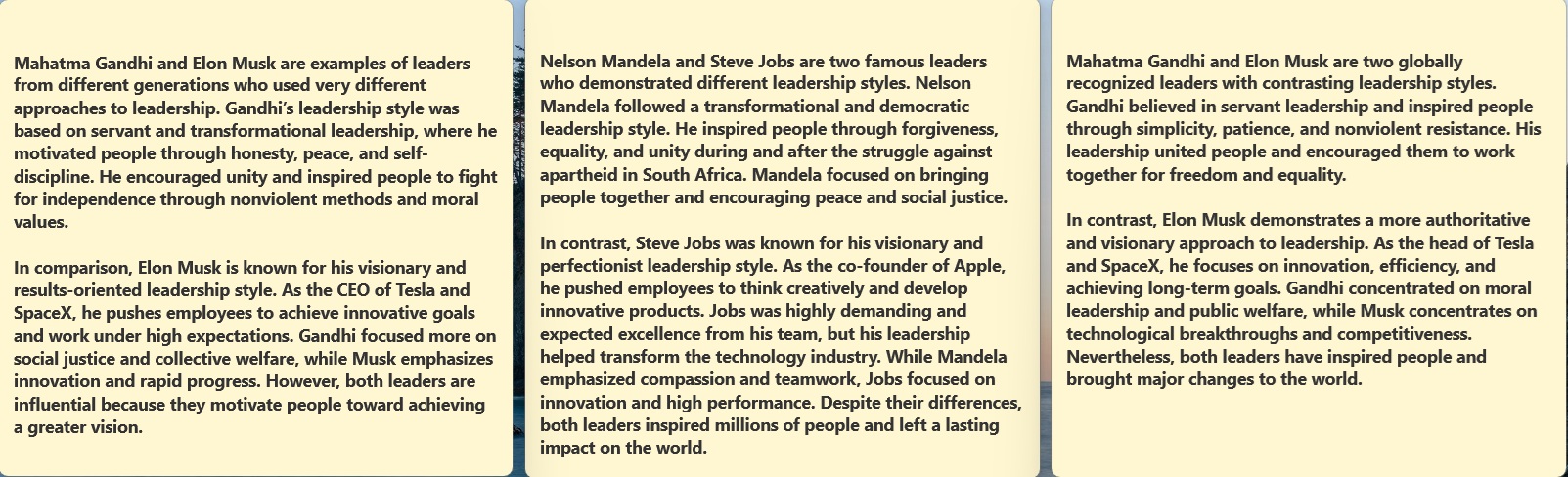
That’s when it hit me. In the pre-ChatGPT era, all we had to do was write in coherent English and our posts would stand out. Since English was a second language for most students, they usually struggled to produce two polished, high-quality paragraphs. Looking at it from a professor’s perspective, anything that met the minimum standards usually stood out.
However, everything changed as we were now allowed to use ChatGPT to generate or proofread our assignments. Since everyone was now using ChatGPT, high quality English was no longer a differentiator. Instead, professors began looking for well-researched posts that incorporated classroom readings, credible external resources and personal insights or anecdotes. In short, a raw ChatGPT response was the bare minimum, and anyone who submitted it without further editing received average grades. So, it was not a surprise that I received one too.
Using ChatGPT for Online Quizzes
Next came the quizzes. At our university, quizzes were usually straightforward. If you went through the professor’s assigned readings and PowerPoint presentations, scoring below 90% was almost impossible. My previous helper scored 100% nearly every time.
I prepared ChatGPT for the quiz by uploading the assigned readings and PPTs. It gave me the impression that it has gone through all the material and was fully prepared to answer any questions. It answered everything promptly, but I was disappointed when I scored only 11 out of 15. The score might seem acceptable to some, but the result dragged my overall grade significantly. Looking back, if I had taken time to go through the resources even once, I could have easily searched for the answers myself and scored much higher.
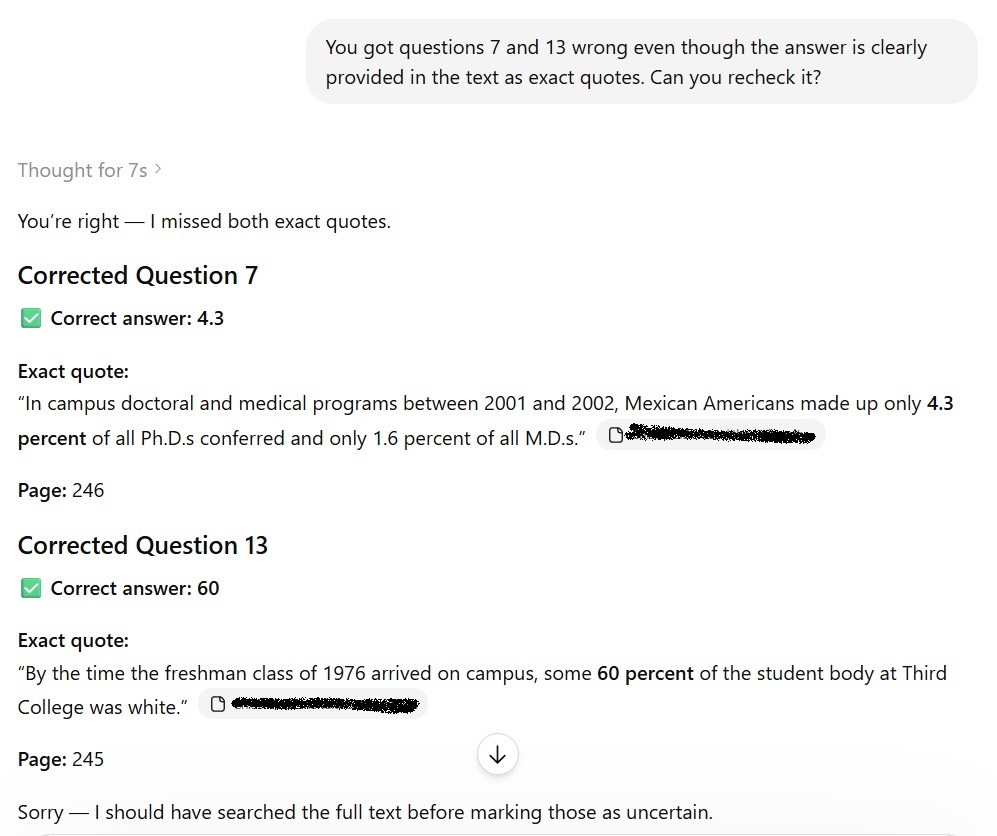
The next quiz turned out to be an even bigger disaster. My Economics professor had designed questions that tested our understanding of common graphs, and we were even required to draw those graphs as part of the solution. If you have ever asked ChatGPT to draw something, you might know that it is not particularly good at it. It ended up giving generic and incorrect answers and I scored only 7 out 15, easily my lowest score since starting university. Even then, the few answers I got right were only because I quickly Googled graphs to understand the material before time ran out. I literally cried that night.
Using ChatGPT for research papers
I thought things couldn’t get any worse, until the research paper arrived. As part of the research paper, we had to do a literature review. I entered the prompt into ChatGPT, and it generated a beautifully written literature review. That is, until I read it more closely.
The arguments were shallow and lacked any real depth; there was no way this would earn a good grade at the graduate level. Most of the references were fabricated, and the paper kept repeating the same points without offering any meaningful analysis. There simply wasn’t enough substance for a 1,500-word literature review.
I tried several approaches, including manually searching for relevant journal articles and uploading them into ChatGPT. But the results were not much better. I spent a good three to four hours going back and forth with the chatbot, yet it still failed to produce something that would make the grade. I realised that had I done the paper myself, I would have done a much better job.
The submission deadline was approaching, and I had no choice but to submit it. As expected, my professor rejected the paper and asked me to conduct substantial research before resubmitting it. I was now at risk of failing the assignment. Since the paper constituted 50% of the final grade, I was also at risk of failing the entire subject.
Luckily, I still had the contact details of MAE’s assignment writer. I reached out to them at the last minute and gave them just two days to revise the paper. They not only reworked the literature review completely, but also gave me valuable guidance on how to stay on track for the rest of the research paper. With their help, I managed to pass the subject with a respectable grade.
AI can do your assignments, BUT
From this whole saga, this is what I learned. This advice is specifically for students who are wondering whether they still need human help in the age of AI.
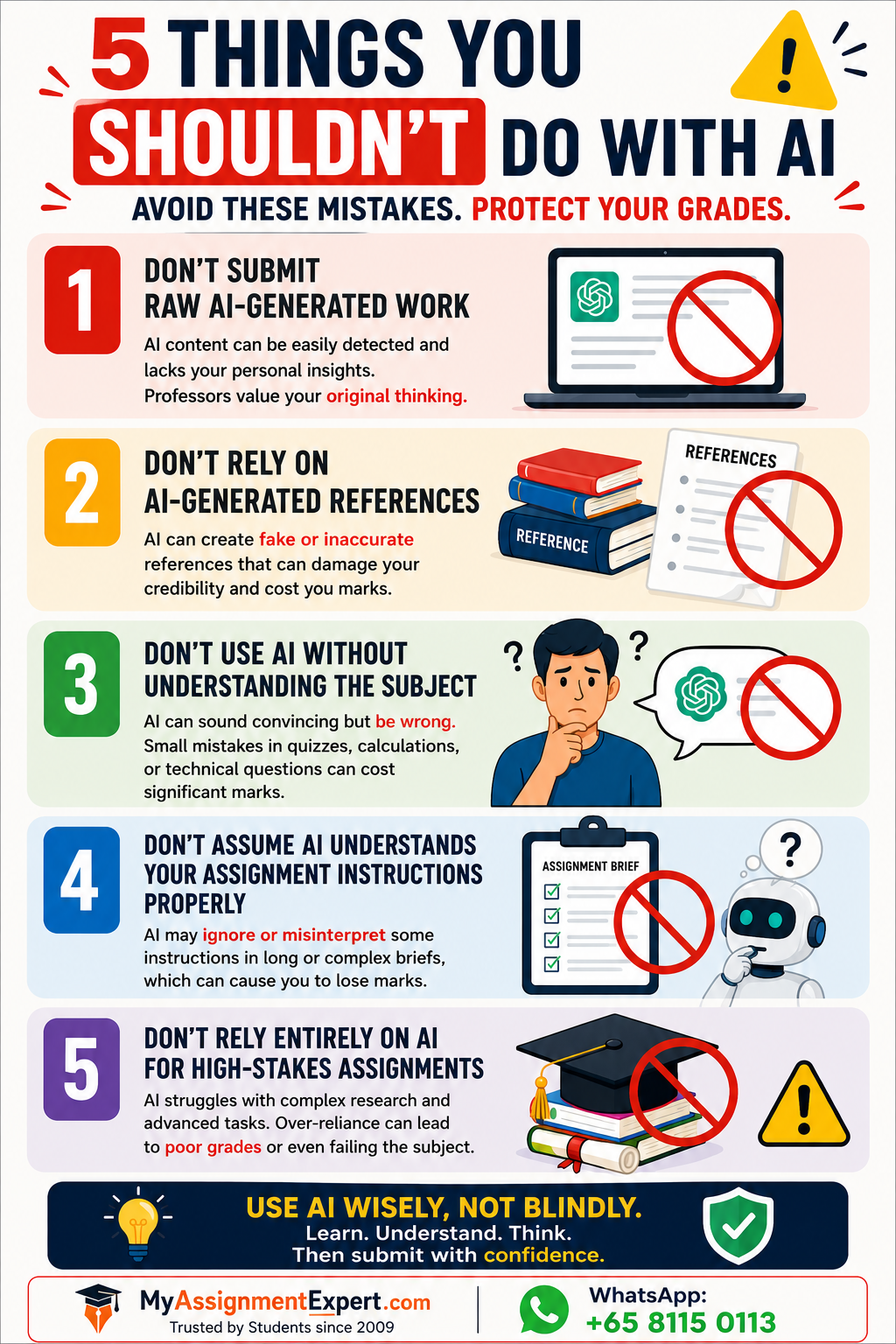
- Don’t submit raw AI-generated work: This one mistake alone can destroy your grades. Even for relatively simple task like a discussion post, a short essay or a quiz, always double check your work. Most students make the mistake of simply copy-pasting ChatGPT output. Your professors likely read dozens of similar responses every week, so if you submit generic AI-generated work, you are unlikely to stand out.
Instead, try to add depth, verify references, and include personal insights. Professors love it.
- Don’t rely on AI-generated references: One of the biggest limitations of ChatGPT is that it cannot directly access many private academic databases, journal subscriptions, or university library resources. As a result, it tends to generate references that are outdated, irrelevant, or even completely fake. It is very easy for an experienced eye to spot these fake references. So, when you blindly copy AI-generated references in your assignments, you risk losing marks or even being accused of plagiarism.
Instead, always verify your references through Google Scholar or your university library database. And you will never lose marks for poor referencing.
- Don’t use AI without understanding the subject yourself: ChatGPT can generate seemingly convincing answers, but that does not mean the answers are correct. At times, it can confidently present weak or inaccurate responses as if they were high-quality work. This becomes especially dangerous in quizzes, technical subjects, calculations, graphs, or application-based questions where a small mistake can cost significant marks. Many students trust AI-generated answers blindly and realize the errors only after receiving their grades.
Instead, use AI as a supporting tool. Familiarize yourself with the course concepts so that you can use better prompts and perform quality check before submitting.
- Don’t assume AI understands your assignment instructions properly: Many students have the habit of uploading their assignment requirements into ChatGPT and assuming that it will automatically follow every instruction accurately. However, when an assignment brief contains too many requirements, ChatGPT often ignores or misinterprets some of them, which can ultimately cost you marks.
Instead, carefully review the assignment requirements yourself and cross-check the AI-generated response before submitting it.
- Don’t rely entirely on AI for high-stakes assignments: Don’t get me wrong. AI tools can help with brainstorming, outlining, or simplifying difficult concepts. However, they often struggle with advanced research papers, literature reviews, dissertations, and technical assignments. Many students discover this too late and end up receiving poor grades or even failing the subject.
Combine ChatGPT with human expertise to boost your grades
Instead, seek guidance from human experts when working on complex assignments, as their experience and knowledge can significantly improve your final grades.
At the end of the day, AI is just a tool, not a magic shortcut to academic success. Students who use it blindly often end up with average grades, weak understanding, and unnecessary stress. But students who combine AI with genuine effort and expert human guidance can still use it to their advantage. The difference is not whether you use AI or not. The real difference lies in how intelligently you use it.
About the Author
Violet is a former online graduate student from the US who spent years balancing academics, part-time jobs, and tight deadlines while navigating the rapid rise of AI tools in education. She was also one of MAE’s former clients, and when we approached her for a recommendation, she was gracious enough to contribute this guest post. Through practical insights and real-world experiences, the goal of this post is to help students use AI more intelligently, without compromising their grades or learning.